Mokshada Ekadashi as it was kept in 2003.
Next date: 20 December 2026Mokshada Ekadashi 2003
Thursday, 4 December 2003, in Ahmedabad
EkadashiGujarati · Hindu
Vaikuntha Ekadashi · Gita Jayanti
Panchang on the day
4
Thursday
Waxing Eleventh
until 15:34
Pisces
- દDa
- ચCha
- ઝJha
- થTha
- Sunrise
- 07:04
- Sunset
- 17:54
- Moonrise
- 15:07
- Nakshatra
- Revati
- until 15:44
- Yoga
- Vyatipata
- until 13:24
- Karana
- Vishti
- until 15:34
- Rahu Kalam 13:50 to 15:12
- Yamaganda 07:04 to 08:25
- Abhijit muhurat 12:07 to 12:51
Why this date
Margshirsh Waxing Eleventh, taken at sunrise
Runs from 3 Dec 13:27 IST to 4 Dec 15:34 IST.
In short
Mokshada Ekadashi is observed on the eleventh day of the bright half of Margashirsha. Its vow story concerns King Vaikhanasa and sage Parvata. Gita Jayanti, celebrated on the same lunar date, is a related observance with its own separate story.
The story
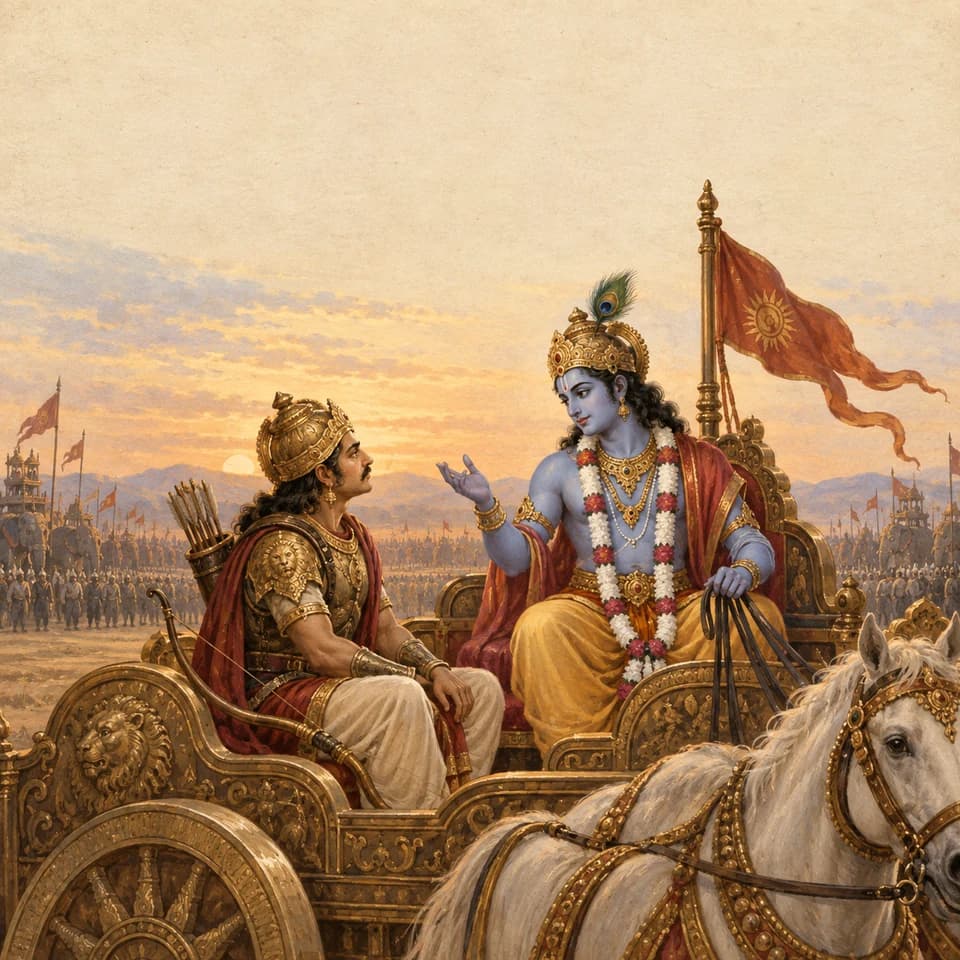
Once Yudhishthira asked Krishna what the Ekadashi in the bright half of Margashirsha was called, which deity was worshipped that day, and how the vow was observed. Krishna called it Mokshada Ekadashi. While explaining worship of Vishnu as Damodara and the importance of the vow, he told an old story.
A king named Vaikhanasa lived in the city of Champaka. He cared for his people as his own children. Scholars who studied the Vedas lived in the city, and the people were prosperous. The king had a kingdom, wealth and a family; outwardly, nothing important seemed to be missing.
One night the king had a dream. He saw his father and ancestors suffering in hell. They wept repeatedly and asked him to free them from that state. The dream ended, but their suffering did not leave his mind.
In the morning, he told the Brahmins about his dream. He said that even his great kingdom no longer gave him joy. Though surrounded by elephants, horses, his wife and children, he could find no peace. What use was his own comfort if his father was suffering? He asked what charity, vow or penance could bring release to his ancestors.
The Brahmins advised him to visit sage Parvata, who lived in a nearby hermitage. The story describes Parvata as a sage who could know the past and future. Following their advice, the king went to the hermitage with Brahmins and other kings.
There, other sages learned in the Vedas sat around Parvata. Vaikhanasa bowed fully before him and touched his feet. Parvata asked about the king and his kingdom. He also asked whether the people, treasury, army and other affairs of the kingdom were doing well.
The king said that his kingdom was peaceful, but a dream had troubled him. He repeated the whole account and asked how his ancestors could be released. Parvata closed his eyes and meditated. After a while, he described an earlier life of the king's father.
The sage said that in a previous birth the king's father had been a Kshatriya proud of his kingdom. At a time favourable for conception, he had left his wife alone and gone to a village on his own business, neglecting his responsibility towards her as a husband. According to the household-duty beliefs of the story's period, the sage regarded this as a fault and named it as the cause of the father's suffering.
Vaikhanasa asked which vow could now bring release. Parvata told him to observe Mokshada Ekadashi in the bright half of Margashirsha. He advised everyone to keep the vow together and offer its merit to the king's father.
The king returned home from the hermitage. When the day arrived, he observed the vow faithfully with the others and offered its merit to his father as the sage had instructed. The story says that flowers showered from the sky, and his father and ancestors were released from their suffering.
As the father rose towards heaven, he blessed his son and wished him well. In this way, the king responded to the plea he had heard in his dream and received his father's blessings. Krishna told Yudhishthira this story to explain the importance of Mokshada Ekadashi.
Why it matters
Vaikhanasa's story is associated with prayers for ancestors' well-being, affection for elders and offering the merit of one's actions for others' benefit. The release described in the story is a religious belief.
What people do
Devotees worship Vishnu, offer tulsi, light a lamp, chant his name and read the vow story. Some sing devotional songs and keep a night vigil. For Gita Jayanti, homes and temples also hold recitations of the Bhagavad Gita and readings of its teachings.
Fasting
Devotees fast according to their health and the practices of their family or tradition. Some eat fruit, while others avoid grains. This vow does not require everyone to give up water as well. The fast is broken on Dwadashi at the appropriate time for one's location and tradition.
Told differently elsewhere
The story appears with some differences in different versions. This entry follows the account set in Champaka, involving the release of the father and ancestors. Gita Jayanti's Krishna–Arjuna dialogue has not been mixed into this vow story. Some traditions calculate Vaikuntha Ekadashi differently, so the two names do not always refer to the same day.
Questions people ask
- When is Mokshada Ekadashi in 2003?
- On Thursday, 4 December 2003 in India. Runs from 3 Dec 13:27 IST to 4 Dec 15:34 IST.
- Why does the date change every year?
- It is kept by the lunar calendar, so its day on the civil calendar moves from year to year.
- Is the date the same everywhere?
- Usually. Where sunrise falls at a different moment the day can differ by one, and the dates here are worked out for India.