Parashurama Jayanti as it was kept in 1985.
Next date: 8 May 2027Parashurama Jayanti 1985
Monday, 22 April 1985, in Ahmedabad
Birth anniversaryIndian · Hindu
Panchang on the day
22
Monday
Waxing Second
until 15:55
Aries
- અA
- લLa
- ઈEe
Puja time
19:04 to 21:28
At dusk, IST
- Sunrise
- 06:12
- Sunset
- 19:04
- Moonrise
- 07:24
- Nakshatra
- Krittika
- until 06:50 next day
- Yoga
- Ayushman
- until 13:44
- Karana
- Kaulava
- until 15:55
- Rahu Kalam 07:48 to 09:25
- Yamaganda 11:01 to 12:38
- Abhijit muhurat 12:12 to 13:04
Why this date
Vaishakh Waxing Third, taken at dusk
Runs from 22 Apr 15:55 IST to 23 Apr 18:08 IST.
In short
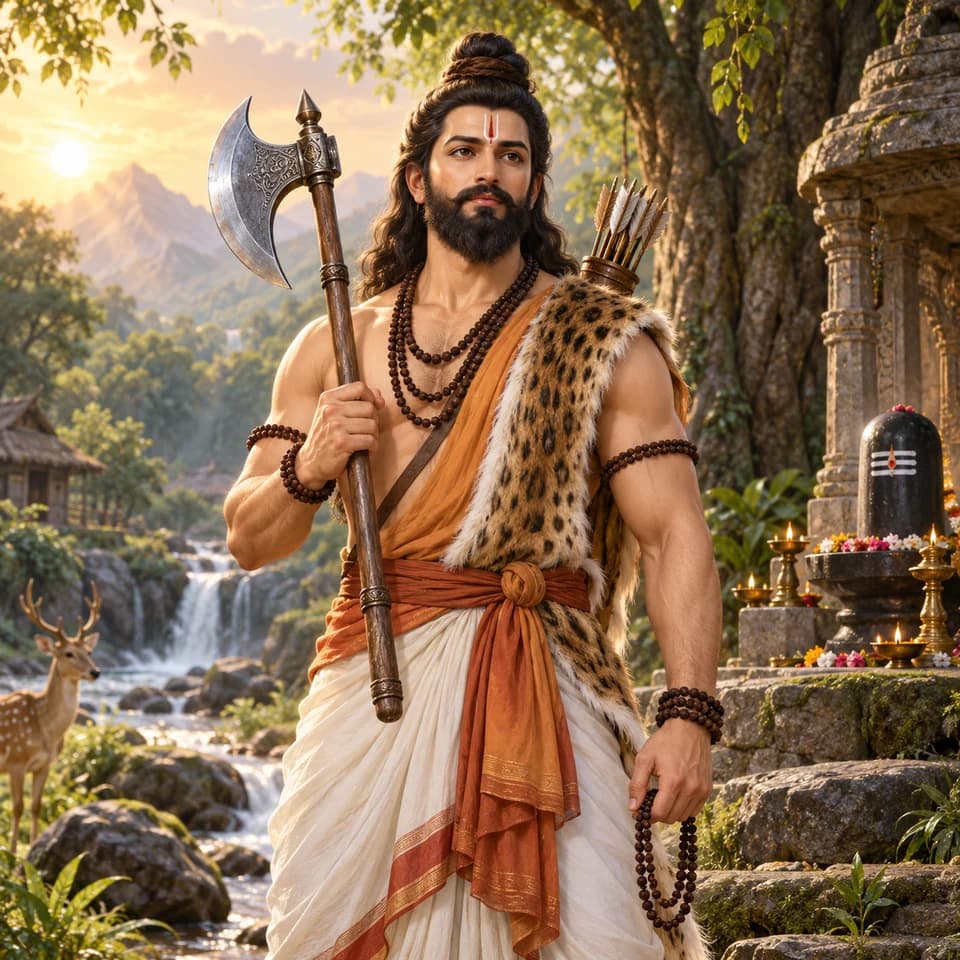
Parashurama Jayanti is celebrated on the third day of the bright half of Vaishakha. It honours Parashurama, the son of sage Jamadagni and Renuka, who is revered as an avatar of Vishnu. Parashu means an axe; Rama became known as Parashurama because he carried this weapon.
The story
King Gadhi had a daughter named Satyavati. Sage Richika of Bhrigu's lineage wished to marry her. Gadhi did not consider the match suitable. He set the sage a condition: he must bring a thousand horses, bright as the moon, each with one black ear. Richika went to Varuna and obtained such horses. After presenting them, he married Satyavati.
Both Satyavati and her mother wanted a son and approached Richika. The sage prepared sacrificial food for Satyavati with Brahmin mantras, and for her mother with Kshatriya mantras, before going to bathe. Satyavati's mother thought that he must have prepared something better for his own wife. She asked her daughter for that portion. Satyavati gave her food to her mother and ate the portion meant for her mother.
When Richika returned, he learnt of the exchange. He told Satyavati that her son would now be harsh and punishing, while her brother would possess spiritual knowledge. Satyavati prayed that this should not happen. The sage agreed that the fierce nature would appear in her grandson rather than her son. Satyavati later gave birth to a son named Jamadagni.
Jamadagni married Renuka, the daughter of Renu. They had Vasuman and other sons. Their youngest son was named Rama. This Rama, born in Bhrigu's lineage, became known as Parashurama. While telling his story to Parikshit, Shukadeva said that he was a manifestation of Vishnu and had destroyed Kshatriya rulers twenty-one times. Parikshit asked what offence the kings had committed to bring about such repeated destruction.
Shukadeva spoke of a king of the Haihaya lineage named Arjuna, known as Kartavirya Arjuna. Through service and worship of Dattatreya, he had gained a thousand arms, unconquerable strength, prosperity, yogic powers and the ability to go wherever he wished. He was proud of his power.
Once, while playing in the Narmada with his queens, he blocked the river's flow with his arms. The water backed up and began flooding Ravana's nearby camp. Ravana, who considered himself a great warrior, could not tolerate this and came to oppose him. Kartavirya captured him, imprisoned him in Mahishmati and later released him. The story uses this episode to show the king's extraordinary strength.
One day, while hunting, Kartavirya reached Jamadagni's hermitage. His army, ministers and riding animals accompanied him. With the help of the hermitage's extraordinary cow, Jamadagni welcomed them all respectfully and arranged a meal. Seeing a cow that could provide for so many people, the king wanted her for himself.
The king valued the sage's cow above even his own riches. He disregarded the hospitality of the hermitage and ordered his men to take her away. They forcibly took the cow and her calf to Mahishmati. The cow cried out, but the king would not release her.
After the king had left, Parashurama returned to the hermitage. When he heard what had happened, he became furious. He took his axe, bow, quivers of arrows and shield, and followed the king. Kartavirya saw Parashurama enter Mahishmati with his weapons, matted hair and deerskin clothing.
The king sent a huge army of elephants, chariots, horsemen and foot soldiers against him. They carried maces, swords, arrows, spears and other weapons. The story gives the army's size as seventeen akshauhinis. Parashurama fought them alone. His axe and arrows shattered the army. Chariots, banners and weapons were destroyed, and many warriors died.
Seeing his army defeated, Kartavirya rushed into battle himself. With his many arms, he placed arrows on five hundred bows at once. Parashurama cut through those arrows with a single bow. The king then charged with uprooted trees and great rocks. Parashurama severed his arms with the axe and killed him. When their father was killed, his ten thousand sons fled in fear.
Parashurama brought the cow and calf back to the hermitage and returned them to his father. He told his father and brothers everything that had happened. Jamadagni did not praise him. He said that Parashurama had sinned by killing a king. He explained that forgiveness was important in a sage's life and that killing in anger was not the right path.
Jamadagni said that forgiveness pleased God. He told Parashurama to remember God, visit holy places and atone for his action. Parashurama accepted his father's instruction. He travelled to pilgrimage places for a whole year and then returned to the hermitage.
Once Renuka went to fetch water from the Ganga. There she saw the Gandharva king Chitraratha playing in the water with celestial women. Attracted by the sight, she watched for a while and did not notice that the time for the fire offering had passed. When she realised the delay, she feared her husband's curse. She returned to the hermitage, placed the water pot before him and stood with folded hands.
Jamadagni became aware of the attraction in his wife's mind and grew very angry. He ordered his sons to kill Renuka. The other sons refused. He then told Parashurama to kill his mother and brothers. Parashurama knew the power of his father's penance and meditation. In the story, he kills his mother and brothers at his father's command.
Jamadagni was pleased and invited Parashurama to ask for a boon. Parashurama did not ask for wealth or power. He asked that his mother and brothers come back to life and not remember that he had killed them. Through the boon, they rose healthy again, as if waking from sleep. His mother and brothers were reunited at the hermitage.
Meanwhile, Kartavirya's sons wanted to avenge their father's death. Their defeat by Parashurama gave them no peace. One day Parashurama went into the forest with his brothers. Seizing this opportunity, the princes came to Jamadagni's hermitage.
Jamadagni was seated in the fire sanctuary, his mind absorbed in God. The princes attacked him there. Though Renuka pleaded with them, they cut off his head and took it away. Overcome with grief, Renuka beat herself and called loudly for Rama.
Parashurama and his brothers heard their mother's anguished cries from afar and hurried to the hermitage. Seeing their father dead, they were filled with grief and anger. Parashurama mourned him. Then he left his father's body in his brothers' care, took up his axe and set out to avenge this abuse of royal power.
Parashurama reached Mahishmati and killed Kartavirya's sons. The story describes a heap of princes' heads and great bloodshed in this terrible battle. His anger did not end there. Taking his father's killing as the cause, he repeatedly campaigned against oppressive Kshatriya rule. The Bhagavata says that he cleared the earth of Kshatriya rulers twenty-one times, and that pools filled with blood formed at Samantapanchaka.
He then brought back his father's head, joined it to the body and placed it on kusha grass. He performed sacrifices and worshipped God, who dwells within everyone. After the wars, he turned towards sacrifice, charity and purification.
As gifts for the sacrifice, he gave lands in different directions to the sages conducting it. He gave the east to the Hotri priest, the south to the Brahma priest, the west to the Adhvaryu and the north to the Udgatri. He gave the lands between those directions to other priests, the central land to Kashyapa and Aryavarta to the supervisor of the sacrifice. The remaining lands were shared among the members of the assembly.
After the sacrifice, Parashurama took the concluding ritual bath in the Sarasvati. The story says that his sins were washed away. Jamadagni regained his own living body and received a place among the Seven Sages. This episode of his father's return to life is connected with Parashurama's worship.
Shukadeva then says that Parashurama set aside the use of weapons and began living peacefully on Mount Mahendra. Siddhas, Gandharvas and Charanas continued to sing his story. The account also says that he will teach Vedic knowledge in the age of the coming Manu. This story of conflict with kings ends with his peaceful withdrawal and the continuing tradition of knowledge.
Why it matters
On Parashurama Jayanti, devotees remember this avatar of Vishnu. His story includes pride in power, injustice against a hermitage, grief over losing family and the destruction caused by anger. Jamadagni's teaching of forgiveness and Parashurama's final turn from weapons towards peace are important parts of the account too.
What people do
Devotees worship Parashurama and Vishnu, read or listen to his story, and offer praises and devotional songs. Charity and distributing prasad according to one's means are also part of the observance. At the Parashurama temple in Chiplun, Maharashtra, the recorded tradition includes lamps, devotional singing and stories of the sage's lineage while remembering his appearance in the evening.
Some devotees keep a vow according to their own tradition. Worship timings, fasting and fast-breaking practices differ between homes and temples. Families follow their own household and temple customs.
Told differently elsewhere
Parashurama Jayanti on the third day of the bright half of Vaishakha is associated with Akshaya Tritiya. The Parashurama temple near Chiplun in Maharashtra holds special celebrations. Temples and families in different regions follow their own practices of worship, storytelling and charity.
Kerala has a separate folk tradition in which Parashurama throws his axe into the sea and gains land. His temple at Thiruvallam is near Thiruvananthapuram. The region has its own temple traditions; the story of reclaiming land from the sea is separate from the Jamadagni and Kartavirya account told here.
Questions people ask
- When is Parashurama Jayanti in 1985?
- On Monday, 22 April 1985 in India. Runs from 22 Apr 15:55 IST to 23 Apr 18:08 IST.
- Why does the date change every year?
- It is kept by the lunar calendar, so its day on the civil calendar moves from year to year.
- Is the date the same everywhere?
- Yes. It is kept everywhere on the day it falls on in Delhi.
Dates in the coming years
- 2027Saturday, 8 MayVaishakh Sud 3 · Puja 19:11
- 2028Thursday, 27 AprilVaishakh Sud 3 · Puja 19:06
- 2029Wednesday, 16 MayVaishakh Sud 3 · Puja 19:15
- 2030Sunday, 5 MayVaishakh Sud 3 · Puja 19:10
- 2031Thursday, 24 AprilVaishakh Sud 3 · Puja 19:05
Last kept19 April 2026