Vat Savitri as it was kept in 1979.
Next date: 4 June 2027Vat Savitri 1979
Friday, 25 May 1979, in Ahmedabad
FastGujarati · Hindu
Vat Savitri Amavasya
Panchang on the day
25
Friday
Waning Fourteenth
until 06:15
Aries
- અA
- લLa
- ઈEe
Puja time
11:16 to 13:57
At midday, IST
- Sunrise
- 05:54
- Sunset
- 19:19
- Moonrise
- 05:27
- Nakshatra
- Krittika
- until 04:24 next day
- Yoga
- Atiganda
- until 03:28 next day
- Karana
- Shakuni
- until 06:15
- Rahu Kalam 10:56 to 12:36
- Yamaganda 15:57 to 17:38
- Abhijit muhurat 12:09 to 13:03
Why this date
Vaishakh New Moon, taken at midday
Runs from 25 May 06:15 IST to 26 May 05:30 IST.
In short
During the Vat Savitri vrat, people hear the story of Savitri and Satyavan and pray for a husband's long life and the family's well-being. Worship of the banyan tree is a familiar custom. The Amavasya observance of Vat Savitri and Vat Purnima on Jyeshtha's full moon share the story but fall on different tithis.
The story
While the Pandavas were living in the forest, Yudhishthira spoke to the sage Markandeya about Draupadi's suffering. More than the loss of his kingdom, he grieved over the humiliation and hardships she had endured. Had the sage heard of another woman with courage and devotion like hers? Markandeya began to tell Savitri's story.
Ashvapati, king of Madra, cared for his people, spoke the truth and kept his word. But he had no children. Hoping for a child, he began a disciplined worship of the goddess Savitri. Each day he made ten thousand offerings into the fire and recited her mantras. Eighteen years passed. At last, the goddess appeared from the fire and invited him to ask for a boon.
Ashvapati asked for a child to continue his family. The goddess said that, through Brahma's grace, he would have a radiant daughter. The king accepted her blessing. In time, his queen Malavi gave birth to a girl. Since she had been born through the goddess Savitri's blessing, she too was named Savitri.
Savitri grew up beautiful and radiant. Her presence made people hesitant, and no one came forward to propose marriage. One day, after worship, she approached her father. Ashvapati told her to find a suitable husband herself and tell him whom she chose. Accompanied by his elderly advisers, she set out in a chariot. She visited forests, pilgrimage places and sages' hermitages, met elders and gave in charity.
When Savitri returned, Narada was sitting with Ashvapati. She bowed to both. Asked about her choice, she told them of King Dyumatsena of Shalva. He had lost his sight, and an enemy had used his vulnerability to seize his kingdom. He had taken his wife and young son to live in the forest. That son, Satyavan, had grown up in the hermitage. Savitri had chosen him as her husband.
Narada praised Satyavan's qualities. He was truthful, brave, wise, generous and devoted to his parents. As a child he had loved horses, making them from clay and drawing pictures, so he was also called Chitrashva. Ashvapati asked whether such a fine young man had any fault. Narada then revealed something grave. Exactly one year from that day, Satyavan's life would end.
Concerned for his daughter's future, Ashvapati asked her to choose someone else. Savitri remained firm. Whether his life was short or long, she had already accepted Satyavan in her heart and would not choose again. A decision first arose in the mind, she explained, was then expressed in words and finally carried into action. Seeing her resolve, Narada agreed to the marriage and gave his blessing.
Ashvapati took Savitri and his priests to Dyumatsena's hermitage and asked for Satyavan's hand for her. Dyumatsena explained that he had no kingdom and his family lived simply in the forest. How could Savitri, raised in a palace, bear that hardship? Ashvapati said he and his daughter understood that happiness and sorrow came and went. They had come with their decision made. Dyumatsena admitted he had once wished for such a match, but had hesitated after losing his kingdom. With both families' consent, the wedding took place at the hermitage.
After her father returned home, Savitri put aside her ornaments and wore simple clothes suited to forest life. She cared for her mother-in-law, respected her father-in-law and willingly did the household work. She lived lovingly with Satyavan and spoke gently to everyone. Life in the hermitage continued, but Narada's words never left her mind. She kept counting the days.
As the appointed day approached, Savitri began a fast of three days and nights, with Satyavan's final day due on the fourth. Dyumatsena was worried. Such a difficult fast would be hard to bear, he said. Savitri asked him not to worry. She had taken the vow with a firm mind and would complete it. He blessed her for its successful completion. She passed the final night thinking anxiously of her husband.
The destined day dawned. Savitri worshipped, made fire offerings and bowed to her parents-in-law and the elders of the hermitage. They blessed her to remain always with her husband. Her parents-in-law said her vow was complete and she should now eat. She explained that she had resolved to take food only after sunset. Her attention remained fixed on the approaching hour.
Satyavan took his axe to collect fruit and wood in the forest. Savitri asked to go with him. He reminded her that she had not travelled through the forest like this before, the path was difficult and fasting might have weakened her. She said she felt no weariness and wished to accompany him that day. Satyavan asked her to seek his parents' permission. She told them that she had hardly left the hermitage for a year and wanted to see the flowering woods with her husband. Dyumatsena said she had asked for nothing until now, so her wish should be granted. She should simply take care not to delay Satyavan's work.
They set out together. Savitri smiled outwardly, but sorrow and fear filled her heart. Satyavan pointed out the beauty of the forest as they walked. She listened while thinking of the coming moment. He gathered fruit until the bag was full, then began chopping wood.
As he worked, Satyavan began to sweat and his head hurt. He came to Savitri, saying that sharp points seemed to pierce his head. His body and heart were also in pain, and he could no longer stand. He needed to lie down. Savitri immediately sat on the ground and placed his head in her lap. Remembering Narada's prediction, she watched the hour.
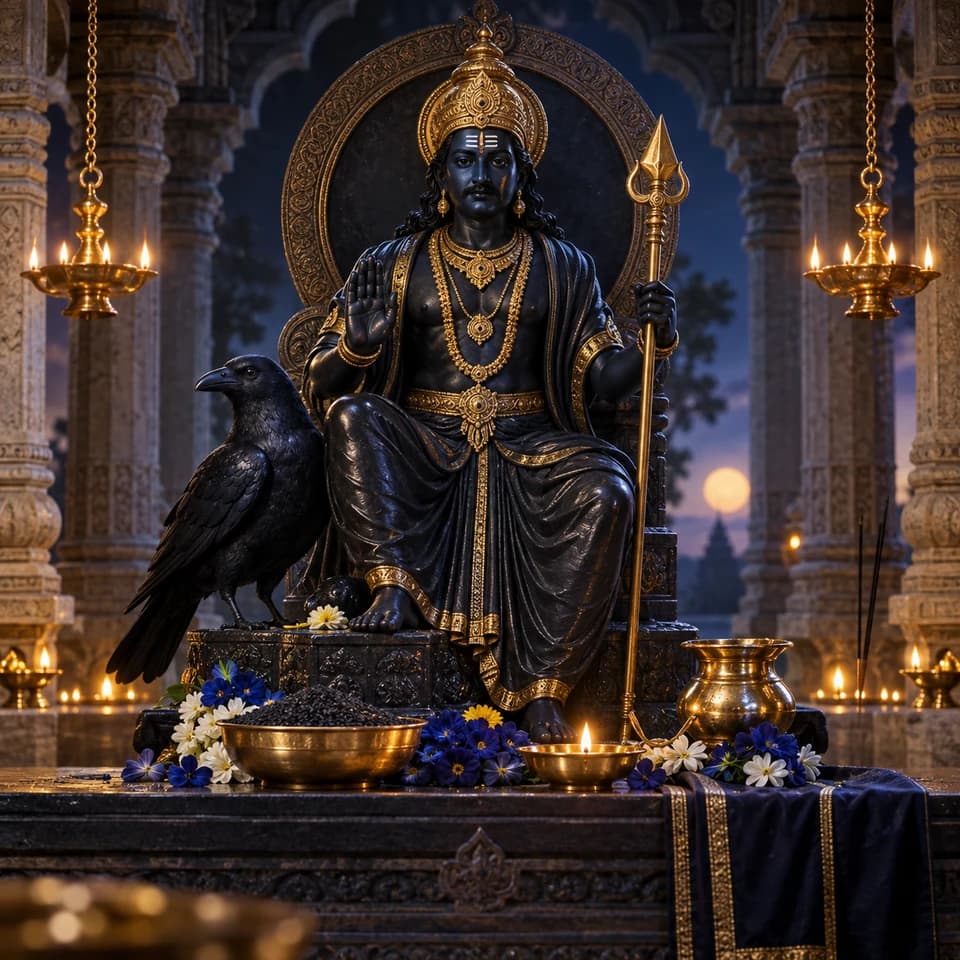
Then Savitri saw a radiant, dark-complexioned figure standing beside Satyavan. He wore red garments and a crown, his eyes were red, and he held a noose. She gently lowered Satyavan's head to the ground, stood up and asked who he was and why he had come. He said he was Yama. Satyavan's life had ended, and he had come to take him.
Savitri asked why Yama had come himself when his messengers usually took people's lives. He explained that Satyavan was so virtuous that he had come personally. He drew a thumb-sized living form from Satyavan's body and bound it with the noose. Breath and consciousness left the body. Yama began walking south with Satyavan's life, and Savitri followed.
Yama told her to return and perform her husband's funeral rites. Savitri replied that she would go wherever her husband was taken. Her vows, respect for elders and love for him gave her strength to continue. She also said that the wise regarded walking seven steps together as the beginning of friendship. In that spirit, she wished to speak with him. She explained that merely entering different stages of life did not establish dharma without self-restraint and right conduct. Dharma lay in fulfilling one's duty well.
Pleased by her thoughtful, gentle words, Yama invited her to ask for a boon other than Satyavan's life. Savitri spoke of her father-in-law. Dyumatsena had lost his kingdom and sight and now lived in the forest. She asked that he might see again and regain strength like the sun or fire. Yama granted this first boon and asked her to return, since she had walked far.
Savitri said that near her husband she felt neither weariness nor distance. She spoke of the value of good company. Even one meeting with good people was beneficial, and friendship with them still more so. Such a bond never went to waste. Yama was pleased again and offered another boon, still excluding Satyavan's life. Savitri asked that Dyumatsena regain his kingdom and never depart from his dharma and responsibilities. Yama granted this second boon too.
Savitri continued beside him. She said Yama governed living beings and took their lives according to law, rather than personal whim. She then spoke of compassion. To avoid harming anyone in thought, word or action, to love and to help were the ways of good people. They showed mercy even to an enemy seeking shelter. Her words pleased Yama like water given to someone thirsty. Offering a third boon, he heard her ask that her father Ashvapati might have a hundred sons to continue his dynasty. He granted it.
Again Yama told her to return. Savitri said that near her husband she gave no thought to the distance travelled. She addressed Yama as Vivasvan's son and Dharmaraja, who gave equal justice to all. People sometimes trusted the good more than they trusted themselves, she said. Their character inspired that confidence. Pleased still more, Yama offered a fourth boon, again excluding Satyavan's life.
This time, Savitri asked that she and Satyavan might have a hundred strong, courageous sons to continue their family. Yama granted the wish. Such sons would be born to her, he said, and she should now turn back because she had come far. But Savitri had more to say.
She returned to the conduct of good people. Their truthfulness kept the sun moving in the sky, and their austerity sustained the earth, she said. Past and future rested upon their goodness. They helped others without expecting gain. Kindness shown to them never went to waste. In their company there was safety, and they protected others. Yama said his respect for her grew with every thoughtful, gentle word about dharma. This time, he invited her to ask for an excellent boon without excluding Satyavan's life.
Savitri now made her request clear. The boon of a hundred sons could not be fulfilled without her husband. Without Satyavan, she wanted neither happiness, prosperity nor heaven. Yama himself had promised her children. To make his promise true, he should restore Satyavan to life. Thus, as her fifth boon, she asked for her husband's life.
Yama released the noose. Satyavan was free and would return to her without illness, he said. He would live with Savitri for four hundred years, perform sacrifices and gain renown. They would have a hundred sons. Ashvapati would also have a hundred sons through Queen Malavi, who would be known as the Malavas. Giving these blessings, Yama departed for his own realm.
Savitri hurried back to Satyavan's body and placed his head in her lap again. He regained consciousness and looked at her lovingly, as though returning from a long journey. He said he had slept a long time. Why had she not woken him? Where was the dark figure who had pulled him away? Savitri replied that he had rested in her lap and Yama had now gone. It was late at night. If he had strength, he should rise.
Satyavan remembered coming to gather fruit, the headache while chopping wood, and lying in her lap. Had the radiant figure seen in the darkness been a dream or real? Savitri said she would explain later. They should return to his parents. Night animals could be heard. Finding the path in darkness seemed difficult, so she suggested fetching fire from a nearby dry, burning tree, lighting wood around them and staying there for the night if necessary.
But Satyavan said his headache had gone and his body felt well. His parents would be anxiously waiting. He had never returned so late. He was their only support in old age. Thinking of their distress, he began to cry. Savitri wiped his tears and prayed that the strength of her vows, charity, worship and truthful speech might bring well-being to her husband and parents-in-law.
Savitri rose, tied her hair and helped Satyavan stand. She hung the fruit bag on a branch and carried his axe herself. Placing his left arm on her shoulder, she supported him with her other hand. Moonlight passing between the trees helped him recognise the path. He said they had reached the same trail used that morning. Where it divided near the palasha trees, they should take the northern branch. His strength was returning as they walked towards the hermitage.
Meanwhile, Dyumatsena had regained his sight and could see his surroundings. Yet he and his wife Shaibya were increasingly worried because their son and daughter-in-law had not returned. They searched nearby hermitages, riverbanks and woods. Each sound raised hope that Satyavan and Savitri were approaching. In their haste, thorns and sharp grass wounded their feet until they bled. The sages persuaded them to return to the hermitage.
The sages offered reassurance. Suvarchas said that, considering Savitri's austerity, self-discipline and conduct, Satyavan must be alive. Gautama and the other sages expressed the same hope. Some saw Dyumatsena's restored sight as a good sign, while others trusted Savitri's vows and virtues. These words gave him some comfort, though he continued to watch for his son's arrival.
That same night, Savitri and Satyavan reached the hermitage. His parents' anxiety ended. The sages congratulated Dyumatsena. His sight had returned, his son was back, and he could now see his daughter-in-law. A fire was lit and everyone sat around it. Asked why they had returned so late, Satyavan spoke of the headache and his long sleep. He remembered nothing beyond that.
Gautama asked Savitri to tell the whole account, since no one yet knew why Dyumatsena's sight had suddenly returned. She explained that this was the day Narada had predicted for Satyavan's death. She described her vow, why she had accompanied her husband, how she had followed Yama and the five boons she had received. The sages praised her for bringing her family out of danger. Everyone then retired peacefully.
The next morning, people from Shalva arrived. They brought news that the enemy who had seized Dyumatsena's kingdom had been killed by his own minister. His supporters were gone and his army had fled. The people had resolved to restore Dyumatsena as king, whether or not he could see. They had come with chariots and an army to escort him. Seeing him healthy and with his sight restored, they were delighted and amazed.
After honouring the sages, Dyumatsena returned to his kingdom with Shaibya, Savitri and Satyavan. He took the throne again, and Satyavan became crown prince. In time, Savitri had a hundred sons. Her father Ashvapati had a hundred sons through Queen Malavi, giving Savitri a hundred brothers. One by one, Yama's boons were fulfilled.
Markandeya told Yudhishthira that Savitri had led herself and both families from sorrow to happiness. He encouraged him that Draupadi too, through her virtues and devotion, would help the Pandavas emerge from their troubles. Hearing the story eased Yudhishthira's heart, and he continued his life in the forest with renewed patience.
Why it matters
Savitri's story values love and devotion alongside her own choice, courage, patience and thoughtful conversation. She asks Yama for blessings for her parents and parents-in-law as well as herself. Her words speak of compassion, trust in good people and helping without expecting gain. Families observing the vrat connect the story with prayers for their marriage and family.
What people do
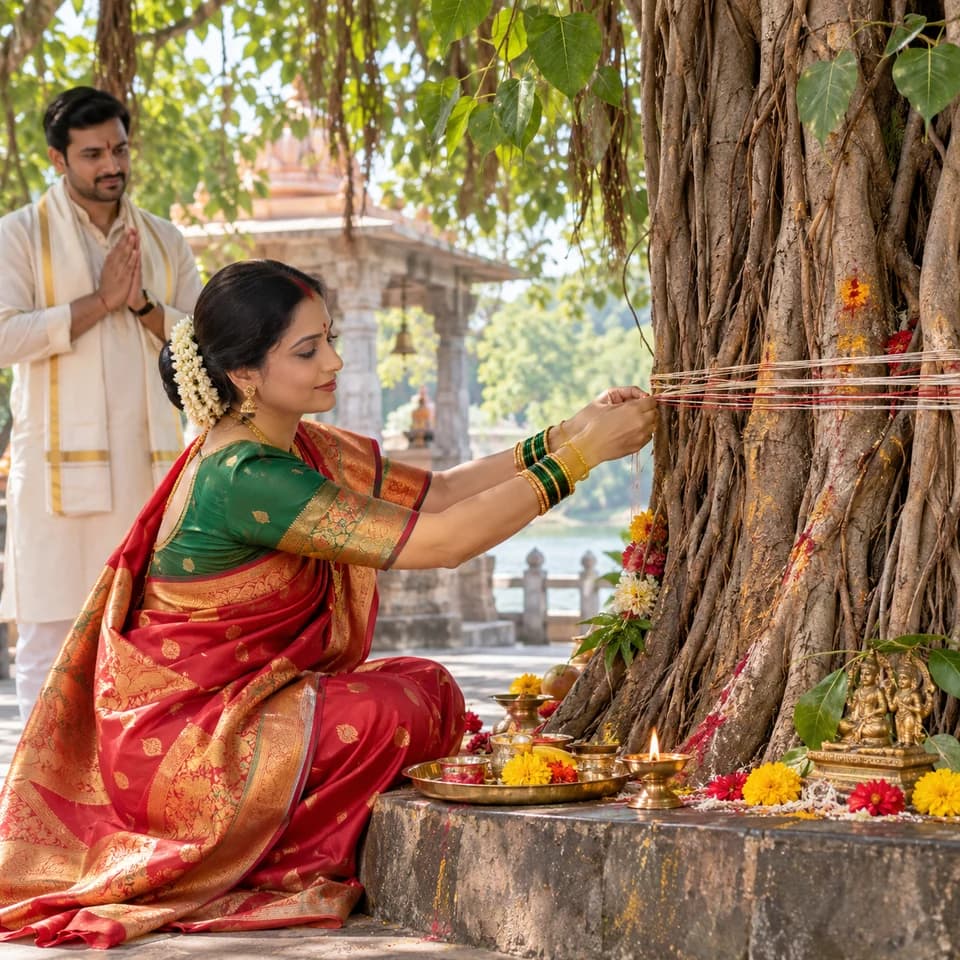
Women observing the vrat bathe and worship according to their tradition. In many places, they visit a banyan tree, offer flowers, turmeric, kumkum or coconut, wind thread around its trunk and walk around it. They read or hear Savitri and Satyavan's story and pray for their husband and family. The number of circuits and offerings varies by household and local custom.
Some families keep a one-day vrat, while others undertake a three-day observance. Fasting and parana follow health and family practices. Those observing Amavasya consult their local panchang. Families observing Vat Purnima follow their tradition on Jyeshtha Shukla Purnima.
Told differently elsewhere
Many northern Indian traditions observe Vat Savitri on Jyeshtha Amavasya. This is the month's name in the northern Purnimanta calendar. The same new moon is Vaishakha Vad Amavasya in the Amanta or Gujarati calendar. The Amavasya observance is familiar in places such as Bihar and Uttar Pradesh. Odisha also celebrates Savitri Amavasya or Sabitri Brata.
Maharashtra celebrates Vat Purnima on Jyeshtha Shukla Purnima. Many families in Gujarat and Goa also follow this full-moon tradition. Gujarati observance dates therefore vary with family custom. The local panchang is consulted according to whether the household follows Amavasya or Purnima. Both may share Savitri and Satyavan's story, while the new moon and full moon remain different tithis.
Questions people ask
- When is Vat Savitri in 1979?
- On Friday, 25 May 1979 in India. Runs from 25 May 06:15 IST to 26 May 05:30 IST.
- Why does the date change every year?
- It is kept by the lunar calendar, so its day on the civil calendar moves from year to year.
- Is the date the same everywhere?
- Yes. It is kept everywhere on the day it falls on in India.