
Kalabhairav Jayanti as it falls in 2027.
Next date: 30 November 2026Kalabhairav Jayanti 2027
Saturday, 20 November 2027, in Ahmedabad
Birth anniversaryIndian · Hindu
Kaal Bhairav Jayanti
Panchang on the day
20
Saturday
Waning Seventh
until 19:17

Cancer
- ડDa
- હHa
Puja time
23:59 to 00:51
At the middle of the night, IST
- Sunrise
- 06:54
- Sunset
- 17:55
- Moonrise
- Not on this day
- Nakshatra
- Ashlesha
- until 23:06
- Yoga
- Brahma
- until 22:11
- Karana
- Vishti
- until 08:18
- Rahu Kalam 09:40 to 11:02
- Yamaganda 13:47 to 15:10
- Abhijit muhurat 12:03 to 12:47
Why this date
Kartik Waning Eighth, taken at the middle of the night
Runs from 20 Nov 19:17 IST to 21 Nov 17:20 IST.
In short
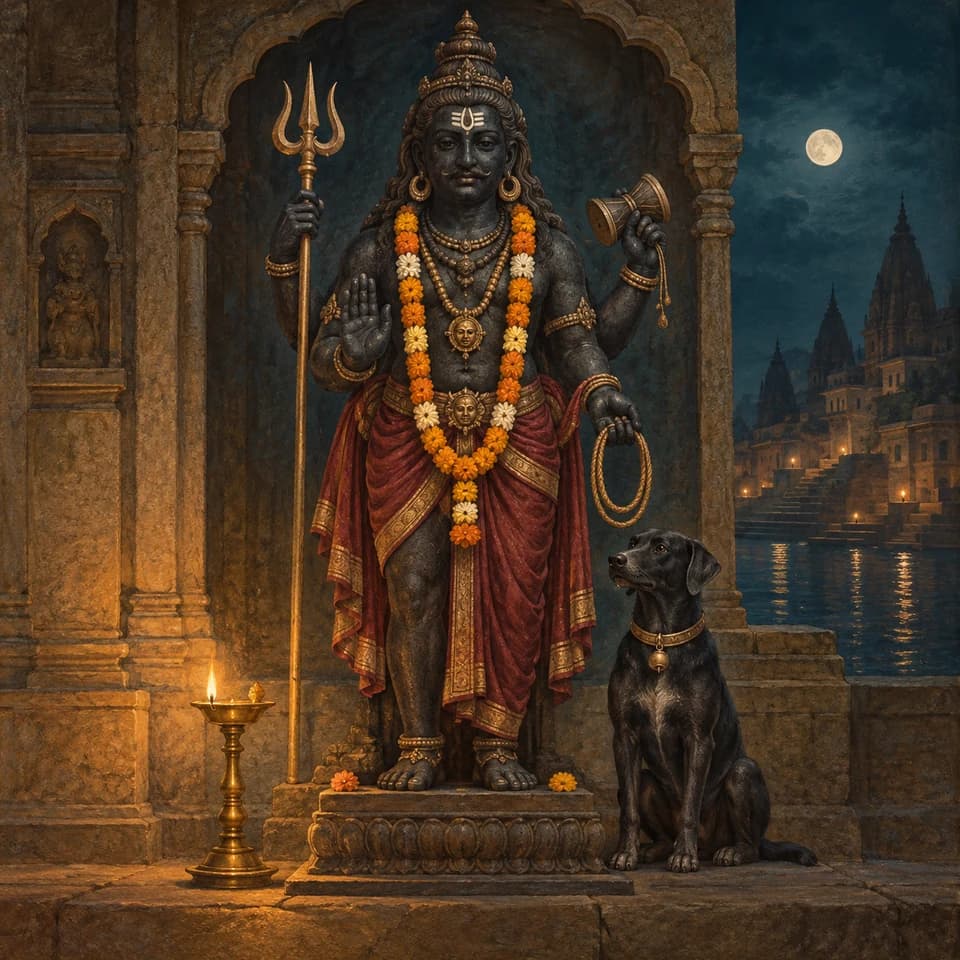
On Kalabhairav Jayanti, devotees remember the appearance of Shiva as Bhairava. The day is also known as Bhairava Ashtami. In Kashi, Kalabhairava is revered as the city's guardian, or Kotwal. His familiar story concerns Brahma's pride, Bhairava's appearance and release in Kashi.
The story
Nandishvara was telling Sanatkumara the story of Bhairava. Once, celestial sages approached Brahma, who was seated on Mount Meru. Bowing respectfully, they asked what single, unchanging truth lay at the root of the universe. Brahma answered by declaring himself the creator, support and highest being of all. He said that there was no one greater than himself.
Vishnu, who was present, was displeased. He told Brahma that this was not right. He declared that he himself was Narayana, the support of the universe, and that Brahma created the world at his command. Both wished to establish their own supremacy. Finally, they asked the four Vedas, present there in embodied form, who the true supreme reality was.
The Vedas said that they would remove the doubt if their answer was accepted as authority. Both agreed. The Rig Veda identified Rudra as the one in whom all beings dwell and from whom everything emerges. The Yajur Veda described Shiva, worshipped through sacrifice and meditation, as the witness of all. The Sama Veda spoke of the three-eyed Shiva, who illuminates the world and is held in the meditation of yogis. The Atharva Veda named Shiva, known through devotion and beyond suffering, as that one reality.
Yet Brahma and Vishnu's doubts remained. Looking at Shiva's outward appearance, they questioned how someone with matted hair, dust on his body, snakes as ornaments and a bull as his mount could be supreme. If Shiva lived with Shakti, how could he be beyond attachment?
Then Pranava, the sound Om, took form before them. He explained that Shiva's Shakti was not separate from him. Shiva was eternal and self-luminous, and Shiva's consort was his own blissful power. Even after this explanation, their ignorance did not disappear.
At that moment, a great light appeared between them. Its brilliance filled the space between earth and sky. Within it they saw a vast figure in human form. Brahma's fifth head grew angry. Soon the figure appeared as the three-eyed Nilalohita Shiva. He held a trident, with snakes and the crescent moon as his ornaments.
Brahma still did not let go of his pride. He said that he recognised Rudra: Rudra had once emerged from his forehead, and he himself had named him Rudra because he had cried. Calling Shiva his son, he told him to seek his protection and promised to save him. Shiva grew angry at Brahma's proud words.
From his anger, Shiva manifested Bhairava, shining with great brilliance. He instructed Bhairava to punish Brahma and explained his names and duties. Because his form was powerful like Kala, he would be called Kalaraja. Even Kala would fear him, so he would be Kalabhairava. He would also be known for restraining the wicked and removing his devotees' sins.
Shiva gave him authority over Kashi. Bhairava would punish wrongdoing in Shiva's city of liberation, and Chitragupta would record people's good and bad deeds. After receiving these blessings, Bhairava cut off Brahma's fifth head with the nail of a finger on his left hand. The head that had spoken disrespectfully received the punishment.
Vishnu became frightened at this sight and praised Shiva with the Shatarudriya mantras. Brahma chanted them too. Both lost their pride and understood Shiva's supreme nature. Shiva was pleased and removed their fear. Nandishvara said here that knowledge remains hidden as long as pride remains.
Shiva then instructed Bhairava to honour Vishnu and Brahma. He told him to carry Brahma's severed head in his hand and observe a vow of atonement. Through this Kapala vow of wandering for alms with a skull, he was to show the world a way of release from the sin of killing a Brahmin.
Shiva manifested a fearsome female form named Brahmahatya. He told her to follow Bhairava until he reached Varanasi. She could enter everywhere except Kashi, and was to leave him when he reached it. After giving these instructions, Shiva, in the form of light, disappeared.
Bhairava wandered through the three worlds carrying the skull. He visited many sacred places, but Brahmahatya would not leave him. The skull did not fall from his hand either. While following the Kapala vow, he once reached Vishnu's abode with his attendants.
On seeing the three-eyed Bhairava with snakes as earrings, Vishnu prostrated on the ground. The gods, sages and celestial women there bowed too. With folded hands, Vishnu offered praises. He told Lakshmi that both were blessed that day: they had seen the indwelling Lord whom yogis meditate upon in their hearts.
Vishnu then asked why Bhairava, the Lord of the universe, was wandering for alms. Bhairava smiled and replied that he had cut off Brahma's head with his nail and was observing this vow to atone for that act.
Vishnu said that only through Bhairava's grace could the meaning of his conduct be understood. Shiva, who dissolves all at the end of the world, was himself beyond the bonds of action; he had freely accepted this conduct. Vishnu expressed the belief that remembering him removes devotees' sins. He said that seeing Bhairava was such a great blessing that even heaven and liberation seemed small beside that joy.
While Vishnu spoke, Lakshmi placed alms in Bhairava's bowl. Bhairava happily set out to seek alms elsewhere. Seeing Brahmahatya following him, Vishnu called to her and asked her to stop pursuing the Lord who carried the trident.
Brahmahatya replied that this gave her an opportunity to serve the Lord too. She wished to purify herself and reach a state without further birth. Despite Vishnu's appeal, she continued to follow Bhairava.
Bhairava told Vishnu that his respectful words had pleased him. He explained that a mendicant is satisfied not only by good food but also by being treated with respect. He then invited Vishnu to ask for a boon.
Vishnu said that seeing Bhairava was already a great blessing. He asked for only one boon: never to be separated from the Lord's feet. Bhairava accepted his prayer and also blessed him to be a giver of boons to the gods.
After blessing Vishnu, Bhairava continued towards Varanasi. As soon as he entered the sacred area of Kashi, Brahmahatya became distressed and descended into Patal. The skull that had not left his hand anywhere else immediately fell to the ground.
When the skull fell before everyone, Bhairava danced with joy. The place became known as Kapalamochana Tirtha: kapala means skull and mochana means release. In Kashi, this bond of his wandering Kapala vow came to an end.
Honouring Kapalamochana Tirtha, Bhairava remained in Kashi. The story describes him there as one who removes devotees' sins. Shiva's assignment to protect and govern Kashi remained associated with his form.
Why it matters
Kalabhairava's story includes the end of pride, acknowledging one's mistake and the path of atonement. His fierce form represents protection and fearlessness for devotees. Worship of him as Kashi's Kotwal also carries a sense of good conduct and responsibility.
What people do
Devotees visit Bhairava temples, offer flowers, oil and black sesame, and pray. Homes and temples hold recitations of Bhairava hymns, remembrance of his name and lamp worship. Some devotees fast and keep a night vigil according to their health and tradition.
Worship, ceremonial bathing and aarti programmes vary by temple. Some emphasise night worship, while others hold morning ceremonial bathing and an evening lamp festival. Follow the temple programme and local calendar.
Told differently elsewhere
Kalabhairava's temple has particular importance in Kashi. Devotees revere him as the city's Kotwal and visit for darshan. Bhairava Ashtami is one of its main festivals. The Kapalamochana story is associated with this devotion to Bhairava in Kashi.
Sringeri in Karnataka has its own tradition of Kalabhairava worship. Bhairava Ashtami includes ceremonial bathing, Vedic recitation, special worship and an evening lamp festival. Temples in different regions decide their festival day and programme according to their own calendars and traditions.
Questions people ask
- When is Kalabhairav Jayanti in 2027?
- On Saturday, 20 November 2027 in India. Runs from 20 Nov 19:17 IST to 21 Nov 17:20 IST.
- Why does the date change every year?
- It is kept by the lunar calendar, so its day on the civil calendar moves from year to year.
- Is the date the same everywhere?
- Yes. It is kept everywhere on the day it falls on in Delhi.
Dates in the coming years
- 2026Monday, 30 NovemberKartik Vad 8 · Puja 00:02in 15 days
- 2027Saturday, 20 NovemberKartik Vad 8 · Puja 23:59
- 2028Thursday, 9 NovemberKartik Vad 8 · Puja 23:57
- 2029Wednesday, 28 NovemberKartik Vad 8 · Puja 00:01
- 2030Monday, 18 NovemberKartik Vad 8 · Puja 23:59
Last kept11 November 2025